Nub theory at 11, 12 and 13 weeks
In the original study, specialists read the nub correctly in 70% of babies at 11 weeks, 99% at 12 weeks and 100% at 13 weeks. The early misses were mostly boys who looked like girls. Those numbers come from live scans read by experts, not from photos of a printout.
Week matters more than anything else in nub theory. At 11 weeks a boy's nub often still lies flat and reads as a girl. By 13 weeks the angle has usually risen enough to separate the two. If your scan is at 12 weeks, the exact day matters too.
Try the nub guesser
Accuracy by week, in the studies
Two sources give week-by-week numbers. Efrat and colleagues (1999) had specialists assign sex in 172 pregnancies at 11–14 weeks and checked the result against karyotyping. A 2025 meta-analysis pooled 28 studies and reported how sensitivity rose across the same weeks.
| Week | Correct in Efrat 1999 | Pooled sensitivity, 2025 meta-analysis | What goes wrong |
|---|---|---|---|
| 11 weeks | 70.3% | 69% | 56% of boys were read as girls |
| 12 weeks | 98.7% | 89% | Girls early in the week are the weak spot |
| 13 weeks | 100% | 96% | Few errors when the image is good |
The two columns measure slightly different things, which is why they don't match exactly. Both point the same way: 11 weeks is unreliable, and accuracy climbs fast over the next two weeks.
Why 11 weeks tends to say "girl"
Every baby starts with the same small bump, the genital tubercle. In boys it gradually tilts upward as the baby grows. Efrat's team found that the angle in male fetuses rose steadily with crown-rump length (CRL, the baby's length on the scan). At 11 weeks many boys simply haven't tilted yet, so their nub still sits flat, which is the "girl" pattern.
That makes early results lopsided. In the 1999 study, 56% of boys were called girls at 11 weeks, but only 5% of girls were called boys. So an 11-week "boy" read is more trustworthy than an 11-week "girl" read. A flat nub at 11 weeks tells you very little.
Why the day within week 12 matters
Efrat's larger follow-up (2006) followed 656 pregnancies and split week 12 into halves:
| Gestational age | Sex could be assigned | Girls read correctly | Boys read correctly |
|---|---|---|---|
| 12+0 to 12+3 | 85% | 91.5% | 99–100% |
| 12+4 to 12+6 | 96% | 99% | 99–100% |
| 13+0 to 13+6 | 97% | 100% | 99–100% |
Two things stand out. Early in week 12, specialists could not assign sex at all in about one baby in seven. And a girl read at that stage was wrong more often than a boy read. The authors suggested waiting for a CRL above 62.6 mm before relying on a female result. Your CRL is usually printed on the scan report.
Boy, girl, or "can't tell"
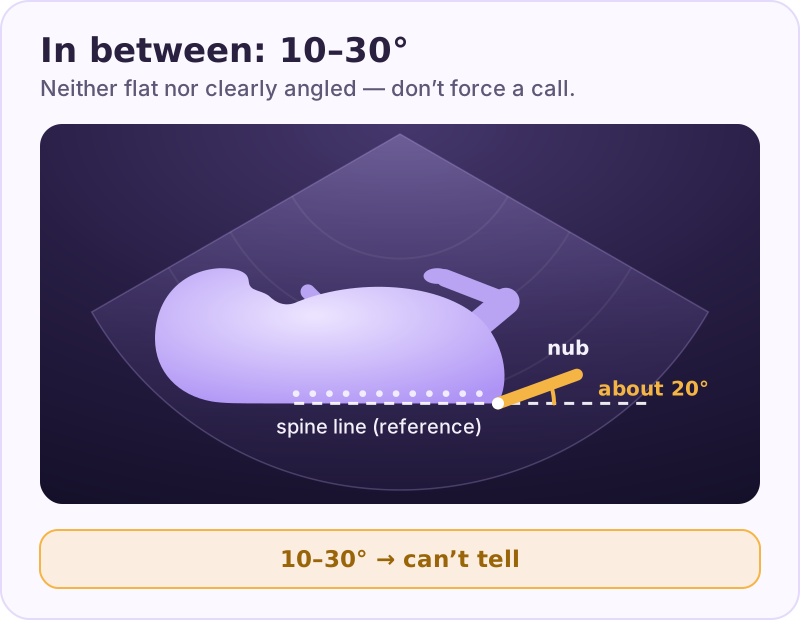
Want to try it on your own scan? Our free nub angle calculator lets you place the two lines on your photo and measures the angle. The photo never leaves your device.
The popular rule has two outcomes: above 30° is a boy, below is a girl. The 2006 study used three:
- More than 30° from the line of the lower spine: boy.
- Less than 10°, parallel or pointing down: girl.
- Between 10° and 30°: undetermined, no call made.
A 2024 study of 312 fetuses at 11–13+6 weeks shows why that middle zone exists. The average angle was 35.9° in boys and 21.6° in girls, and the best single cutoff was about 28°. At that cutoff the angle caught 92% of boys but also labelled about 15% of girls as boys. When two different readers measured the same images, their agreement was only moderate. Reading a nub angle is harder than the rule makes it sound.
For a step-by-step on measuring the angle yourself, see angle of the dangle.
What these numbers don't cover
Every figure on this page comes from trained sonographers working on the live ultrasound machine. They could adjust the image until they had a true side-on view of the spine. No study has measured how accurate a nub read is when someone looks at a phone photo of a printed scan, which is what most parents have. We would expect it to be lower, because the image is smaller, often slightly tilted, and can't be adjusted.
So treat a nub guess from your printout as a fun clue. If you want a confident answer at this stage, ask your provider. They may tell you, or suggest a prenatal blood test. Our week-by-week guide covers the options.
What makes a 12–13 week image readable
- A true side profile. The baby's spine should run as a clear line along the bottom of the image. The angle is measured against that line.
- Baby lying fairly straight. If the baby is curled up or the legs cover the area, the nub can't be seen properly.
- The right week. Many parents have their dating or nuchal translucency scan between 11 and 13+6 weeks. Later in that window is better for the nub.
- No tilt. A slightly angled view can make a flat nub look raised, or the reverse. Tilt is the most common reason online guesses disagree.
Not sure where the nub is on your picture? Start with how to find the nub on your scan, then compare it with the boy vs girl examples.
How BabyPeek does it
In BabyPeek you measure the nub and mark the placenta side on your own scan, answer the skull-theory questions, and the app adds the Chinese calendar and a playful Photo Pick. It labels how much evidence each method has, shows one majority verdict and turns it into a shareable reveal.
FAQ
Sources
- Efrat Z, Akinfenwa OO, Nicolaides KH. First-trimester determination of fetal gender by ultrasound. Ultrasound Obstet Gynecol. 1999;13(5):305–7. PubMed
- Efrat Z, Perri T, Ramati E, Tugendreich D, Meizner I. Fetal gender assignment by first-trimester ultrasound. Ultrasound Obstet Gynecol. 2006;27(6):619–21. PubMed
- Alfuraih AM, Almajem BM, Alsolai AA. The predictive accuracy of anogenital distance and genital tubercle angle for first-trimester fetal sex determination. Diagnostics (Basel). 2024;14(16):1811. PubMed
- Amankona E et al. Effectiveness of prenatal ultrasound in fetal sex identification: a systematic review and meta-analysis. J Ultrasound. 2025;28(3):563–74. PubMed
Written by the BabyPeek editorial team from the studies above. How we research and write. For entertainment, not medical advice.